















Short answer: The best home alarm without a subscription is the system that takes over the tasks you would otherwise outsource to a monitoring centre. A subscription mainly buys one thing you cannot arrange yourself: an alarm receiving centre that checks your alert and calls in the police. Once you know who can respond to an alert in your situation, the choice is made fairly quickly.
Our solution
Alarm system without a subscription
Equipment that is yours, alerts that come straight to you, and no monthly fee that keeps running for as long as you live in the house.
See the options
Key points
- A subscription mainly buys follow-up: an alarm receiving centre that assesses the alert before anyone is sent out.
- Without a subscription, the alert comes to you and you decide what happens — call, go and check, or ask someone nearby.
- Verification determines the priority, not whether the police come: the Dutch police state that they also respond when verification fails, but not with the highest priority.
- Always calculate a subscription over five years: the monthly fee times sixty is the fair comparison with a one-off purchase.
- Always ask who owns the equipment and what happens if you cancel or move house.
- Alert routes are the most important choice: only a notification in the app, or SMS and a phone call as well.
- The alarm is not your first measure: according to the Dutch police, homes with the Dutch Police Label for Secure Housing (Politiekeurmerk Veilig Wonen) are up to 90% less likely to suffer a successful burglary, and that starts with locks, hinges and lighting.
“Without a subscription” sounds like a question about price, but it isn't. It is a question about tasks. A security company with a monthly contract takes a number of things off your hands, and if you cross out those monthly costs, those tasks end up somewhere else — usually with you. So the best home alarm without a subscription is not the most expensive or the most extensive system, but the system that fits how you handle those tasks.
That is why in this article we first take a subscription apart. Then we look at which parts you can take over yourself, which you cannot, and what to look out for if you want to carry on without a monthly contract.
What do you actually buy with a subscription?
A monthly fee paid to a security company is almost never a single service. It is a bundle, and that bundle roughly consists of two parts: the follow-up of an alert, and the use of the equipment.
The alarm receiving centre and verification
The part you cannot recreate yourself is the private alarm receiving centre (in Dutch: particuliere alarmcentrale, PAC). This is a staffed centre that assesses an incoming alarm before anyone is sent out. Such a centre is not an open market: in the Netherlands, security organisations need a licence from the Dutch Ministry of Justice and Security, and without that licence it is prohibited by law to carry out security work.
That check is there for a reason. For hold-up alarms, the Dutch police describe that since 1 July 2022 private alarm receiving centres first verify for themselves whether an alarm is serious or has been set off by accident. The police name camera footage as the most convenient way of verifying, because it shows quickly and clearly what is going on.
Important to know: verification mainly determines the priority, not whether the police respond at all. If verification fails — no camera footage, no telephone contact with the location — the Dutch police will, according to the same explanation, still respond, just not with the very highest priority. Even then, the emergency control room first assesses the situation based on the known facts and circumstances.
The equipment, the maintenance and the contract
The second part of the bundle is physical: the control panel, the sensors, the app, sometimes the installation and the maintenance. This is where the difference on paper is biggest. With many subscription models, the equipment remains the property of the provider. You pay for its use, and when you cancel, the system in principle goes back or stops working.
That is not a criticism of those providers — it is simply a different model, and for some people the right one. But it is the question you need to ask before you sign: who owns the equipment, what happens if I cancel, and what happens if I move house? The answer determines whether a monthly fee is a service or a rental price.
Which tasks do you take over yourself?
If you carry on without a subscription, the middleman disappears. The alert does not go to a centre that calls first, but straight to you. In concrete terms, you take over three things.
Assessing. You decide for yourself whether an alert is real. In practice that is often simpler than it sounds, because you know exactly who should be at home and which sensor went off. A detector with its own name — “back door”, “attic room” — makes a huge difference here.
Responding. You decide what happens: go and check yourself, call a neighbour or family member, or call the police yourself if the situation looks suspicious. That also means thinking about the moments when you cannot respond yourself: on holiday, abroad, or during working hours without your phone to hand.
Maintaining. Replacing batteries, testing the app notifications now and then, and checking after a renovation or a new layout whether the sensors are still well placed. Little work, but it is work that would otherwise be included in the subscription.
What you do not take over is the professional follow-up. A system without a subscription alerts you; it does not independently call in a patrol service or the police. That is the honest limit of this model, and it is worth knowing before you choose.
What should you look for in a home alarm without a subscription?
Because you are the one who responds, the requirements shift. It is less about “what can the system do” and more about “does the alert reach me at the moment it matters”. Four points are decisive here.
How does the alert reach you?
This is the most important point and at the same time the one most often skipped. A system that only alerts via the app depends on the internet and on a phone that is switched on. For many households that is fine. But if the Wi-Fi drops or the power goes out, that single alert route goes too.
Systems with a second route cover for that. With the ShieldLink® Pro and the ShieldLink® Elite you can insert a SIM card. The system then alerts you not only via the app but also by SMS and a phone call, even when the Wi-Fi or power fails. In that case you can even operate the system with SMS commands. So don't just look at the number of sensors, but at the number of ways you get notified.
What happens during a power cut or Wi-Fi outage?
An alarm system that fails as soon as the power fails offers no protection at exactly the moment you need it. So look for two back-ups. The first is in the control panel itself: in the ShieldLink® Pro, the built-in backup battery lasts up to 24 hours. The second is at least as important: the external siren works independently of the control panel and has its own backup battery, so there is still sound even during a fault.
How do you arm and disarm it?
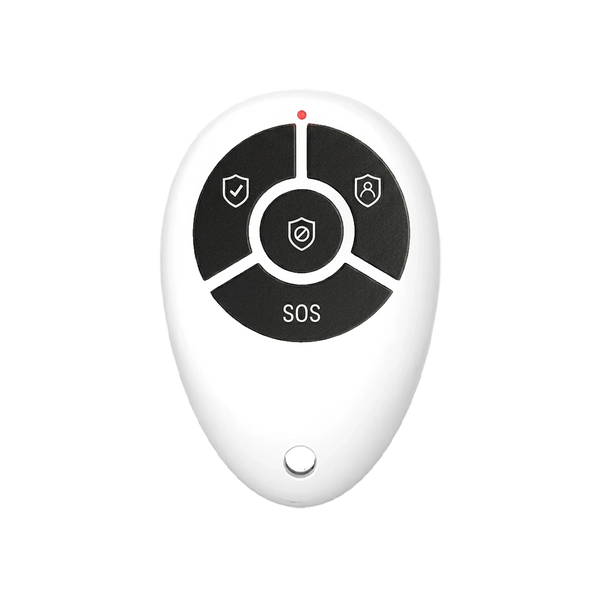
A system that is cumbersome to switch on and off will, in the long run, simply stop being switched on. So check whether the controls suit the household. The ShieldLink® Lite works with RFID key fobs, which is handy for children or guests who don't need to remember a code. With the Plus and the Pro you arm and disarm via the Dutch-language touchscreen, the app or the QuickLink remote control; the RFID key fobs do not work on those two control panels. With the Pro, control via Google Assistant or Alexa is also possible.
Can you expand it later?
If you own the system, you usually buy in stages. Start with the places where a burglar gets in — back door, patio doors, basement window — and expand from there. A modular system can later be supplemented with extra sensors, smoke detectors that trigger the full alarm, or a video doorbell in the same app. That is exactly the advantage of ownership: you are not tied to a package you chose five years ago.
A second alert route with no monthly fees

ShieldLink® Pro — Complete
The control panel with the most alert routes: besides the app, with a SIM card you can also receive SMS and a phone call, even if the Wi-Fi or power fails. The built-in backup battery lasts up to 24 hours and the external siren has its own battery.
View the kitThe five-year calculation
A monthly fee feels small and a purchase price feels big. That is exactly why they are so hard to compare. The simplest way to see through it: take the monthly fee, multiply it by sixty, and put that next to the one-off purchase of your own system. Five years is a reasonable period, because an alarm system keeps working without problems for that long, and most people live in the same house for at least that long.
Include two things in that comparison that easily stay out of view. First, the start-up costs: with a subscription, installation and connection costs often come on top of the monthly fee. Second, the residual value: equipment that is yours moves with you and keeps its value, whereas rented equipment goes away again when you cancel.
What the calculation does not show is the follow-up. A centre that is staffed 24 hours a day costs money, and rightly so. So the question is not which outcome is lower, but whether that follow-up is needed in your situation.
When is a subscription actually the sensible choice?
There are situations in which a subscription with professional monitoring is the better choice, and they deserve to be mentioned.
- There is nobody who can respond. With a second home, a holiday home far away or a long absence, an alert on your phone is of little use if there is nobody nearby who can do something.
- Your insurer or permit sets requirements. For business premises or a high insured value, a certified installation with alarm transmission to a monitoring centre may be a condition. That is stated in your policy or in the insurer's requirements — check this in advance.
- You don't want to make the decision yourself. Not everyone wants to weigh up at three in the morning whether to go and check. That is a legitimate reason, and that is what you are paying for.
If none of this applies to you, a subscription mainly buys you a service that in practice you already provide yourself. That is the moment when “without a subscription” becomes the logical choice.
Finally, a sober note on the whole trade-off: the alarm system is not your first measure. The Dutch police state that homes with the Politiekeurmerk Veilig Wonen are up to 90% less likely to suffer a successful burglary, and that label starts with good locks, hinges and lighting. An alarm is the finishing touch, not the starting point. This can also be seen in the broader figures: according to Statistics Netherlands (CBS), the number of registered thefts, embezzlements and burglaries in the Netherlands in 2025 was 3% lower than in 2023, within a long-term decline in traditional crime.
Which kit suits your situation?

ShieldLink® Lite — Complete
For those who are at home or nearby and are happy with notifications in the app. Arming and disarming is done with RFID key fobs, handy for children and guests.
View product
ShieldLink® Plus — Complete
Dutch-language colour touchscreen and control via app or remote control. The external siren keeps working if the power fails.
View product
ShieldLink® Pro — Complete
The most alert routes: the app, and with a SIM card also SMS and a phone call. Backup battery of up to 24 hours in the control panel.
View productOur solution
Alarm system without a subscription
Calculate your current monthly fee over five years and compare it with a system you buy once and that stays yours — even when you move house.
See the options
What is the best home alarm without a subscription?
The best home alarm without a subscription is the system whose alert routes match who can respond: if there is always someone who can act on an app notification, a system that alerts via the app is enough; if you also want to stay reachable when the Wi-Fi or power fails, choose a control panel that also raises the alarm by SMS and a phone call.
Frequently asked questions
Will the police come if I don't have a subscription?
A system without a subscription alerts you, not the police. If you judge the alert to be suspicious, you call them yourself. The Dutch police state that verification mainly determines the priority: even without successful verification they respond, but not with the very highest priority, and the emergency control room first assesses the known facts and circumstances.
How do I compare the costs of a subscription with my own system?
Multiply the monthly fee by sixty and put that next to the one-off purchase price. With the subscription, also add the one-off installation and connection costs, and bear in mind that rented equipment has to go back when you cancel, whereas your own system moves with you.
Does a home alarm without a subscription also work without Wi-Fi?
That depends on the control panel. A system that only alerts via the app needs internet. Control panels with a SIM card, such as the ShieldLink® Pro and Elite, also alert by SMS and a phone call, even if the Wi-Fi or power drops out.
Will I get a discount on my home contents insurance with an alarm without a subscription?
That varies per insurer. Discounts are usually linked to a quality label or a certified installation, not to the alarm system itself. Check your policy conditions or ask your insurer before you count on a discount.
Can I install a home alarm without a subscription myself?
Yes. Wireless systems are plug & play: you stick or screw the sensors onto doors, windows and in rooms, and pair them via the control panel or the app. If you want to qualify for the Dutch Politiekeurmerk Veilig Wonen, the Dutch police refer you to recognised companies for the installation.
Sources
- Dutch police (Politie) — Follow-up of hold-up alarms
- Dutch police (Politie) — What exactly does a private alarm receiving centre do during verification?
- Dutch police (Politie) — What happens if verification by a PAC fails?
- Dutch police (Politie) — Politiekeurmerk Veilig Wonen
- Het CCV (Dutch Centre for Crime Prevention and Safety) — Politiekeurmerk Veilig Wonen
- Justis (Dutch screening authority) — Private security and investigation (Wpbr)
- CBS (Statistics Netherlands) — Traditional crime such as theft and violence unchanged


