















Short answer: The biggest advantage of a wireless alarm system is that nothing needs to go into your walls. As a result, you can install it yourself in an afternoon, you don't pay an installer, you can expand it later one sensor at a time and you take it with you when you move. You can also reach places where a cable is hard to run, such as a shed, garage or outbuilding. So the advantage isn't better detection — the sensors do the same job as wired ones — but everything around it: time, cost, mess and flexibility.
Our solution
Home alarm system
Wireless, install it yourself and no subscription — a system you put up today and expand later whenever it suits you.
View the options
Key takeaways
- No cables through walls, so no drilling and chiselling, no dust and no making good afterwards.
- No installer needed: in the Dutch market, installation work for an alarm system accounts for roughly €400 to €1,000 — that amount disappears if you install it yourself.
- You expand one sensor at a time, whenever your home or situation changes.
- The system moves with you and therefore also suits a rented home: nothing stays behind when you leave.
- Places without cable ducts become reachable: you simply link a shed, garage or outbuilding to the same control panel.
- The detection itself is no better or worse than with a wired system; the advantage lies in everything around it.
Anyone looking into an alarm system soon faces the choice between wireless and wired. Wireless has become the usual choice for homes, but "flexible" and "easy" don't say much until you know what they actually save you. Below are the advantages one by one, with what they mean in practice — and, at the end, where they stop.
1. You install it yourself in an afternoon

Stick, pair, test
A wired system needs cables from every sensor to the control panel: chasing channels, removing skirting boards, feeding cables through floors. With wireless, you stick a contact on the frame, pair it with the control panel and test whether it reports. Door/window contacts such as the LockSense come with an adhesive pad, so you don't even need a drill.
Installing it yourself: how it worksThe practical result: you don't need to take a day off for an engineer, there's no dust in the house and you don't have to touch anything up afterwards. You can fit out an average home in an afternoon, including testing each sensor in its position.
2. No installation costs
The second advantage follows directly from the first. In the Dutch market, installation work for an alarm system accounts for roughly €400 to €1,000, depending on the size of the home and how much cutting and chasing is needed. With a wireless system you install yourself, that cost disappears completely.
That's no small difference: in many homes the installation work costs more than the equipment itself. If you want to see the full calculation — purchase, installation and any monthly fees side by side — it's in our article on the cost of an alarm system.
3. Expand one sensor at a time
Homes change. An extension is built, the attic becomes a bedroom, a summer house is added. With a wired system, every new sensor means a new cable. With wireless, you pair an extra sensor and you're done.
That also makes it easier to start small. You don't need to know on day one how your whole home should be protected: start with the front door, the back door and the living room, and expand where you notice it's needed. Individual contacts and motion detectors cost a fraction of an installer's visit.
4. It moves with you
A wired system belongs to the house. A wireless system belongs to you: control panel off the wall, sensors off the frames, and you put it back up in your new home.
For tenants, that's often the deciding advantage. The Dutch central government (Rijksoverheid) states that in the Netherlands a tenant may make small changes that can be undone without much cost; anything permanent must be reversed when you leave. Sensors on adhesive strips fall comfortably into the first category. You leave no cables or chased channels behind, and you simply take your security with you.
5. The shed and garage too
A cable to the shed at the bottom of the garden means digging. A wireless sensor in that shed means: stick it on and test whether the control panel sees it. That makes places reachable that are often left out with a wired system — even though that's exactly where the bikes, tools and garden machinery are kept.
For longer distances there are sensors made for the job. The LockSense Elite and ShieldSense Elite, together with the ShieldLink® Elite control panel, bridge distances of up to around 500 metres, for example to a warehouse or outbuilding further across the property.
6. One app for more than burglary
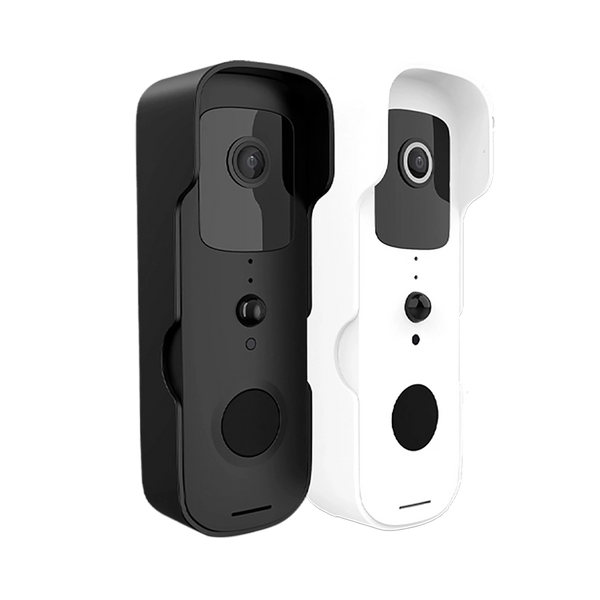
Because everything talks wirelessly to the control panel, you can connect more to it than intrusion detection. You can link the SmokeAlert Link smoke detector to the ShieldLink® system, so that smoke triggers the full alarm and you get a notification on your phone — even when you're not at home. You can link the BellMate video doorbell to the control panel and operate it in the same app.
That saves separate apps and separate notifications: you see in one place what's happening at home.
Where the advantages end
To be fair: wireless also has drawbacks. Sensors run on batteries that you replace from time to time, range isn't unlimited with thick concrete walls, and a system you install yourself doesn't qualify for the certificate some insurers require for business premises. Those drawbacks, and how significant they are in practice, are worked out in our article on the disadvantages of a wireless alarm system.
If you're still torn between the two systems, our article wireless or wired: how to choose for your situation will help.
Complete kits to get started

ShieldLink® Lite — Complete
The entry-level option: control via the app and with RFID key fobs, so family members and guests can quickly arm and disarm the system.
View the kit
ShieldLink® Plus — Complete
Dutch-language colour touchscreen and an external siren that keeps working independently of the control panel during a power cut.
View the kit
ShieldLink® Pro — Complete
With the optional SIM card, alerts via SMS and phone call, even if the Wi-Fi or power goes down.
View the kitWhat are the advantages of a wireless alarm system?
You install a wireless alarm system yourself without drilling and chiselling, which removes installation costs of roughly €400 to €1,000 in the Dutch market; you expand it one sensor at a time, take it with you when you move, and can also cover a shed, garage or outbuilding with it — while the detection itself works just as well as with a wired system.
Frequently asked questions
What is the biggest advantage of a wireless alarm system?
That nothing needs to go into your walls. Everything else follows from that: you install it yourself, you don't pay an installer, you expand one sensor at a time and you take it with you when you move. The detection itself is comparable to that of a wired system.
Can I install a wireless alarm system myself?
Yes. You stick or screw the sensors in place, pair them with the control panel and test that each sensor reports. You can fit out an average home in an afternoon. Having it installed mainly makes sense if your insurer requires a certified installation.
Is a wireless alarm system suitable for a rented home?
Yes, especially there. In the Netherlands a tenant may make small changes that can be undone without much cost. Sensors on adhesive strips fall into that category, and when you leave you simply take the whole system with you.
Can I expand a wireless alarm system later?
Yes. You pair an extra sensor with the existing control panel, without new cables. That means you can start small with the doors and the living room, and expand when your home or situation changes.
Does a wireless alarm system also work in a shed or garage?
Yes, as long as the control panel can reach the sensor. Test each sensor in its final position before you fix it in place. For longer distances there are sensors such as the LockSense Elite and ShieldSense Elite, which bridge up to around 500 metres with the Elite control panel.
Our solution
Alarm system without a subscription
Installed by you, bought once and yours — even if you move or your home changes.
View the options
Sources
- Rijksoverheid (Dutch government) — May I alter or renovate my rented home? (in Dutch)
- Installation costs: indicative market amounts for the Netherlands, September 2026
- Specifications of LockSense, SmokeAlert, BellMate and the Elite sensors: our own product pages, checked on 20 September 2026


