















Short answer: Don't start with the technology, start with your insurance policy. Many Dutch insurers use the Verbeterde Risicoklassenindeling (VRKI, the Dutch risk class system) to determine what security they expect; that class depends on what you store, what it is worth and how attractive it is. Once you know your class and what your policy requires, three practical things determine the rest: the distance between the furthest detection point and the panel, whether there is already wiring in place, and whether you also want detection outdoors.
Our solution
Alarm system for your business
From shop to warehouse: installed wirelessly without building work, expandable per building, and without an ongoing monthly contract.
View the business systems
Key points
- Your policy comes first. What your insurer requires sets the minimum for your choice — check this before you buy.
- The VRKI determines your risk class based on the attractiveness, value and storage location of your goods.
- According to the CCV (the Dutch Centre for Crime Prevention and Safety), security consists of three types of measures: organisational, structural and electronic — an alarm is the third, not the first.
- Wireless wins in existing buildings because you don't need cable ducts or chiselling, and the system moves with you.
- Distance is the real limitation in warehouses and on large sites: LoRa sensors bridge up to 500 metres.
- Is there already wiring? Then you don't have to throw away existing sensors — you can convert them to wireless.
- Outdoor detection is possible without a power point with a solar-powered siren and motion detector in one.
For a home, the question “which alarm system?” is mostly a matter of preference. For commercial premises it's different: there is an insurer at the table, there is often more value with less supervision, and the buildings themselves are larger and more awkward. This article follows the order in which those decisions are made in practice.
Start with your policy, not the technology
The most common mistake is to choose a system and only then check what the insurer thinks of it. That's the wrong order, because your policy may set requirements that narrow your choice in advance — and if you don't meet them, that can have consequences at the moment you file a claim.
So first get out your policy conditions, or call your broker. The question you want answered is simple: what security measures does my insurer expect for these premises and these contents, and does it have to be a certified installation? For many smaller businesses the answer is surprisingly light. For premises with valuable or attractive stock it can turn out heavier, and then it's good to know that before you buy anything.
What the VRKI is and why it steers your choice
Behind those requirements there is almost always the same instrument. The CCV describes the Verbeterde Risicoklassenindeling (VRKI) as a proven instrument for determining the burglary risk of commercial buildings and homes in the Netherlands. For many Dutch insurers it is also an important instrument for setting the premium of burglary insurance.
The class follows from three things at once: how attractive your goods are to criminals, their value, and where they are stored. A warehouse full of tools or electronics therefore scores higher than an office with desks and chairs, even if the building is the same size.
It's useful to know how the CCV classifies the measures, because that explains why an alarm system is never the whole answer. There are organisational measures (making sure doors really are locked and no keys are left in the lock), structural measures (good locks and hinges, burglar-resistant windows and doors) and electronic measures (alarm systems, access control and cameras as a necessary addition). Which combination is needed depends on the class.
That order is not a formality. An alarm that goes off after someone has got through a poorly locked door in thirty seconds comes too late in the process.
Why wireless often wins in commercial premises
Once the requirements are clear and a self-installed system is sufficient, wireless usually works out better in existing buildings. Three reasons.
No building work. Running cables in an existing warehouse or shop means ducts, wall penetrations and work that disrupts operations. You mount wireless sensors where they are needed, even on a concrete wall or a steel door.
Grow in phases. You don't have to plan the entire building in one go. Start with the entrances and the room with the most value, and expand when the layout changes — and that happens more often in a business than at home.
It moves with you. If you rent the premises, or grow into a larger location within a few years, the system simply comes with you. A wired installation stays behind.
Distance is the real issue
What rarely comes up with homes is often the first bottleneck for businesses: does the signal reach? A warehouse with thick walls, a second building at the back of the yard, a workshop on the other side of the site — those are distances an ordinary sensor isn't made for.
There is a different technology for that. The ShieldSense Elite and LockSense Elite work with LoRa and, combined with the ShieldLink® Elite panel, bridge distances of up to 500 metres, with a signal that penetrates walls and floors well and a fully encrypted connection. The ShieldSense Elite also has tamper protection, which is more relevant in an unsupervised location than at home.
Practical approach: measure the distance from the furthest point you want to secure to where the panel will be mounted, and choose on that basis. Not the other way round.
Do you already have a wired system?
Many commercial buildings still have an old wired installation: door/window contacts on the doors, motion detectors in the hall, and a panel no one dares to touch any more. Not all of that has to go.
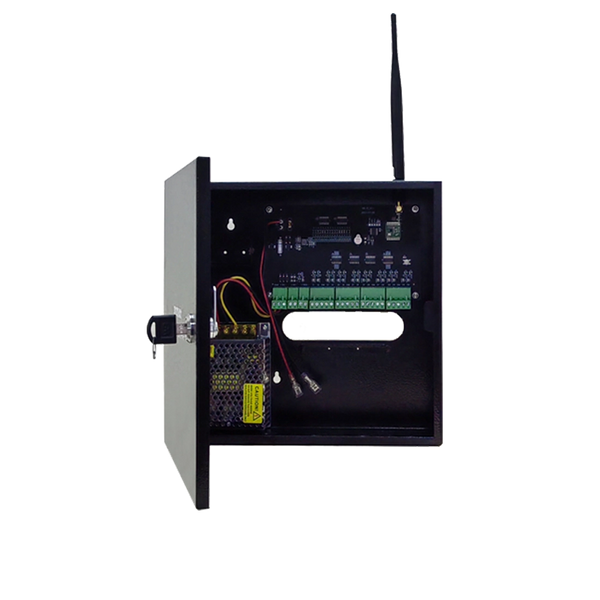
With the ShieldBridge® you convert up to sixteen wired zones into wireless signals, so existing door/window contacts and motion detectors remain usable within a modern wireless system. Both NC and NO sensors are supported, each zone has its own LED indicator so you can see what is active, and there are connections for an external siren, additional wired equipment and an optional backup battery. The connection runs on 433 MHz with a stated range of up to 150 metres in open field.
That doesn't just save money, it mainly saves tearing out and repairing wiring that is perfectly fine.
Façade, yard and grounds
For a home, security starts at the door. For a business it often starts in the yard: at the loading dock, along the façade, at the outdoor storage. There, the hardest problem is usually not detection but power, because there is rarely a socket on the property boundary.
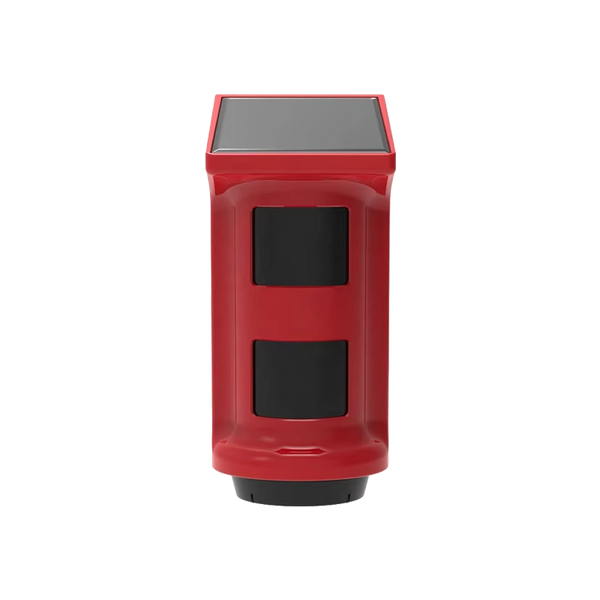
The ShieldDefender® combines an outdoor siren and a motion detector in one solar-powered device, so no fixed power connection is needed. You link it wirelessly to a ShieldLink® system and can use it as a detector, as a siren, or both. The PIR sensor has two sensitivity levels and is pet-friendly, and both the siren duration and the lighting are adjustable. If you specifically want no sound outside, the siren can be switched off completely for a silent alarm function — handy on a site where you would rather go and check yourself than wake up the neighbourhood.
Which systems suit commercial premises?
The Elite line is made for situations where distance and reliable range matter most.

ShieldLink® Elite — Complete
The panel for businesses and larger locations, with touchscreen, app control and room for a SIM card for alerts by text message and phone call.
View product
ShieldSense Elite
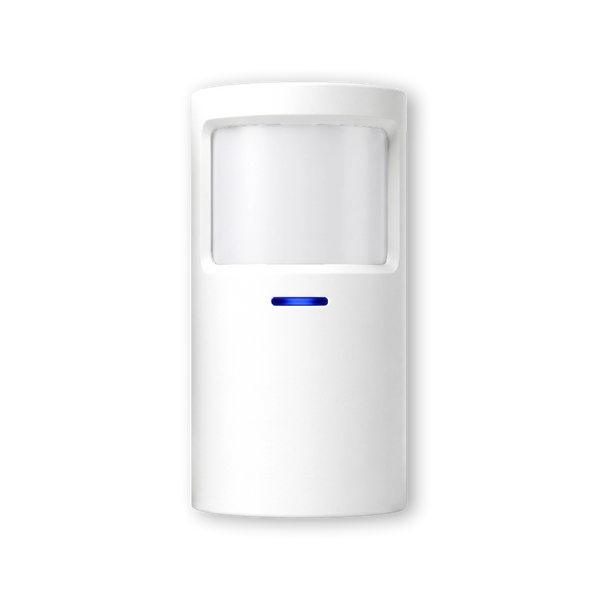
Motion detector with LoRa up to 500 metres, strong signal penetration through walls and floors, an encrypted connection and tamper protection.
View product
LockSense Elite
Door/window contact from the same Elite line, for entrances far from the panel — a back door in a warehouse or an outbuilding in the yard.
View productOne thing to be honest about in a business decision: a system without a subscription alerts you, and does not independently call in a monitoring centre or security patrol. For premises where no one is nearby and a fast on-site response is required, a subscription with follow-up may be the better choice. If someone is nearby, or you mainly want to know immediately yourself what is happening, your own system does exactly what is needed — without an ongoing monthly fee.
Our solution
Alarm system for your business
Worked out per situation: shops, hospitality, warehouse, storage, large site or construction site. So you can see straight away what fits your premises.
View the business systems
What should you look for in a wireless alarm system for businesses?
First check what your insurer requires based on the VRKI risk class, make sure the organisational and structural measures are in order, and then choose based on distance: measure how far the furthest detection point is from the panel, see whether you can reuse existing wired sensors, and arrange outdoor security with equipment that doesn't need a fixed power connection.
Frequently asked questions
What is the VRKI and does it affect me?
According to the CCV, the Dutch Verbeterde Risicoklassenindeling is an instrument for determining the burglary risk of commercial buildings and homes. The class depends on the attractiveness and value of your goods and on where they are stored. For many Dutch insurers it is an important instrument when setting the premium, so in practice you come across it through your policy.
What measures does an insurer expect?
That varies by class and by insurer. The CCV distinguishes three types: organisational, such as making sure doors really are locked; structural, such as good locks and hinges; and electronic, such as an alarm system, access control and cameras. Which combination is needed is stated in your policy conditions.
Does a wireless system work in a large warehouse?
That depends on the technology. An ordinary sensor is made for home distances. The Elite line works with LoRa and, combined with the ShieldLink Elite panel, bridges distances of up to 500 metres, with a signal that penetrates walls and floors well. Measure the distance from the furthest point to the panel before you choose.
Can I reuse my existing wired sensors?
Often, yes. With the ShieldBridge you convert up to sixteen wired zones into wireless signals, with both NC and NO sensors supported. That way, existing door/window contacts and motion detectors remain usable within a modern wireless system, without tearing out the wiring.
How do I secure the yard or façade without a power point?
With solar-powered equipment. The ShieldDefender combines an outdoor siren and motion detector in a device that runs independently on solar power and links wirelessly to a ShieldLink system. You can use it as a detector, a siren or both, and switch the siren off completely for a silent alarm if you wish.
Sources
- Het CCV (Dutch Centre for Crime Prevention and Safety) — Verbeterde Risicoklassenindeling (VRKI 2.0)
- Het CCV (Dutch Centre for Crime Prevention and Safety) — Inbraakbeveiliging
- Justis (Dutch screening authority) — Particuliere beveiliging en recherche (Wpbr)
- Rijksinspectie Digitale Infrastructuur (Dutch Authority for Digital Infrastructure) — Vergunningvrij frequentiegebruik


